ClementSaint · †99Clement of Rome was a late first-century bishop of Rome, often identified as the fourth Pope. As one of the Apostolic Fathers, he was considered a contemporary and acquaintance of the Apostles, with some traditions suggesting he was personally ordained by Saint Peter. His leadership occurred during the formative years of the early Church in Ancient Rome. He is primarily remembered for his correspondence with the church in Corinth, which serves as an early foundational text regarding the authority of church leaders.
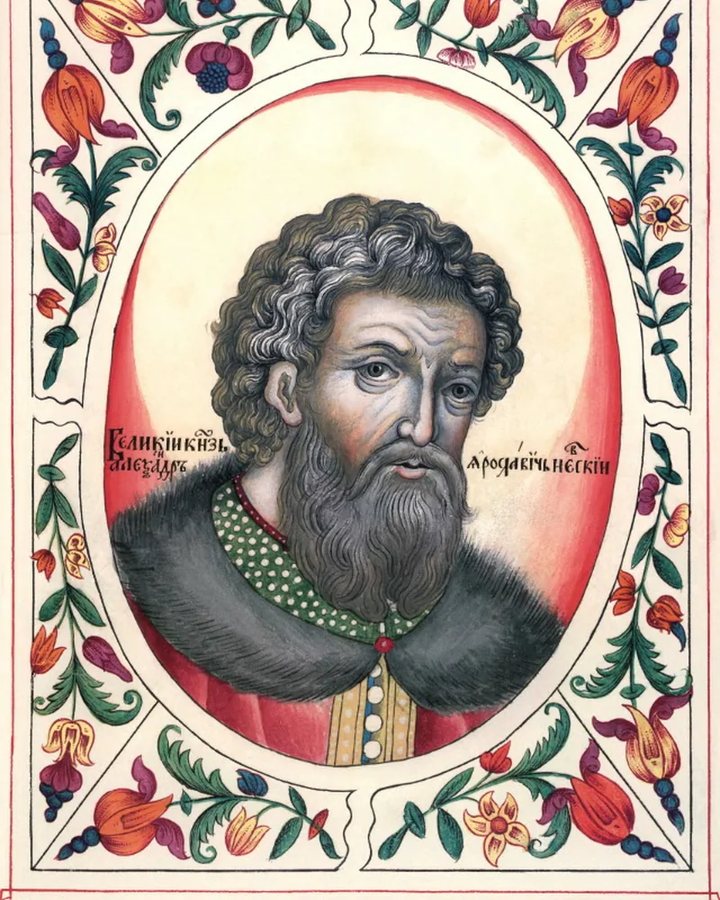 Alexander NevskyRight-believing · 1220–1263Alexander Nevsky was a 13th-century ruler of several Russian principalities, including Novgorod and Vladimir. Born in Pereslavl-Zalessky around 1221, he became a prominent military leader known for defending his territories against foreign incursions. He is most famous for his victories over Swedish forces at the Neva River and against German crusaders during the Battle on the Ice. By choosing to pay tribute to the Golden Horde, he sought to protect the Eastern Orthodox Church from Western influence. He died in Gorodets in 1263 and is venerated as a saint in both Catholic and Orthodox traditions.
 Olga of KievEqual-to-the-apostles · 890–969Olga of Kiev was a 10th-century regent of Kievan Rus' who governed on behalf of her son, Sviatoslav, from 945 to 957. Following the death of her husband, Prince Igor, she famously exacted violent retribution against the Drevlian tribe for his murder. As the first Rurikid ruler to be baptized, she paved the way for her grandson, Vladimir the Great, to establish Christianity as the state religion. She is honored in the Eastern Orthodox tradition as a saint with the title "Equal to the Apostles."
 Vladimir the GreatEqual-to-the-apostles · 956–1015Vladimir the Great (c. 958 – 1015) was Prince of Novgorod from 970 and Grand Prince of Kiev from 978 until his death. Born the illegitimate son of Sviatoslav I, he seized power after a fratricidal struggle, expanded his realm to the Baltic Sea and defended its frontiers. Originally a pagan, he adopted Christianity in 988 and brought it to Kievan Rus'. The Catholic Church and the Eastern Orthodox Church both canonised him as Saint Vladimir.
 Martin ISaint · 598–655Martin I was the Bishop of Rome from 649 to approximately 654. Originally serving as a papal legate in Constantinople, he was elected to the papacy without seeking the customary approval from the Byzantine emperor. He is primarily remembered for his firm stance against Monothelitism, a theological doctrine supported by the imperial court. This opposition led to his arrest by Emperor Constans II, his subsequent imprisonment, and his eventual exile to Cherson, where he died in 655. He is recognized as a saint in the Catholic, Orthodox, and Anglican traditions.
 Yaroslav the WiseRight-believing · 978–1054Yaroslav the Wise was the Grand Prince of Kiev, ruling from 1019 until his death in 1054. Born around 978, he previously served as the Prince of Rostov and the Prince of Novgorod. After a period of intense conflict with his half-brother Sviatopolk for control of the Kievan throne, Yaroslav emerged victorious to consolidate his power. A significant patron of culture, he promoted literacy and commissioned the construction of Saint Sophia Cathedral. He is recognized as a saint in both the Catholic and Eastern Orthodox traditions.
 Vladimir II Monomakh1053–1125Vladimir II Monomakh was a prominent Grand Prince of Kiev who reigned from 1113 until his death in 1125. A skilled military leader, he conducted numerous campaigns against the Polovtsian nomads to protect the lands of Kievan Rus'. Beyond his political and martial achievements, he was a significant writer, most notably composing a didactic instruction for his descendants. He is venerated as a saint within the Eastern Orthodox Church and is remembered for his efforts to stabilize the realm through social reforms and diplomatic congresses.
 Nestor the ChroniclerVenerable monastic · 1056–1114Nestor the Chronicler was an influential monk and historian living in Kievan Rus' during the late 11th and early 12th centuries. Born in Kyiv around 1056, he joined the Monastery of the Caves in 1073 and later served as a hierodeacon. He is widely recognized for his literary contributions, including hagiographies and historical accounts, and is frequently associated with the authorship of the Primary Chronicle. His work helped shape the historical record of the region during a formative era.
 Yaropolk I of KievSaint · †978Yaropolk I of Kiev was the Grand Prince of Kiev, ruling from 972 to 978. As the eldest son of Sviatoslav I, he initially held Kiev while his father campaigned, but his reign was defined by a violent civil war against his brothers. Following the death of his father, Yaropolk fought his brother Oleg and eventually became the sole ruler of the Rus' lands. His rule ended in 978 when his brother Vladimir seized power, leading to Yaropolk's death in an ambush.
 Sviatoslav II of Kiev1027–1076Sviatoslav II of Kiev was a 11th-century ruler of Kievan Rus' who served as the Grand Prince of Kiev from 1073 until 1076. As the fourth son of Yaroslav the Wise, he initially governed the Principality of Vladimir before inheriting Chernigov. He was a key member of a three-way ruling triumvirate alongside his brothers, Iziaslav and Vsevolod, which managed the realm's affairs for many years. A descendant of the Rurik dynasty, he is recognized as a saint in the Orthodox tradition.
 Peter MogilaSaint · 1596–1646Peter Mogila was a 17th-century theologian and the Metropolitan of Kyiv, Galicia, and all Rus' from 1633 to 1646. Born into a noble Moldavian family in Suceava, he later moved to the Ruthenian Voivodeship following his father's death. He became a central figure in the Kyiv Pechersk Lavra, where he worked to strengthen Eastern Orthodox spirituality and education. Through diplomatic efforts with the Polish king, he successfully restored the legal status of the Orthodox Church within the Polish-Lithuanian Commonwealth.
 Duchess Alexandra of Oldenburg1838–1900Duchess Alexandra of Oldenburg was a 19th-century Grand Duchess of Russia and a nun who dedicated her life to medical charity. Born in Saint Petersburg to Duke Peter of Oldenburg and Princess Therese of Nassau-Weilburg, she was the great-granddaughter of Emperor Paul I. Although raised in the Lutheran faith, she converted to Eastern Orthodoxy following her marriage to Grand Duke Nicholas Nikolaevich. Following a difficult marriage and a paralyzing accident, she eventually settled in Kyiv, where she founded a convent and hospital to serve the impoverished.
 Anna PorphyrogenitaSaint · 963–1011Anna Porphyrogenita was a Byzantine princess born in Constantinople in 963, who later became the grand princess consort of Kyiv. As the daughter of Emperor Romanos II and sister to Emperors Basil II and Constantine VIII, her status as a legitimate imperial daughter was highly prestigious. Her marriage to Grand Prince Vladimir the Great played a significant role in the Christianization of the Rus' realm, as Vladimir converted to Eastern Christianity partly due to the influence of her religious traditions and the union itself.
 Igor II of KievPassion bearer · 1096–1147Igor II of Kiev was a 12th-century monarch who served as the Prince of Chernigov and briefly as the Grand Prince of Kiev. Born in 1096, he was the son of Oleg I of Chernigov and succeeded his brother, Vsevolod II. His reign was marked by significant political instability and resistance from the people of Kiev. After a brief period of rule, he was defeated by his rival, Iziaslav II, leading to a period of imprisonment and eventual monastic life.
 Ingegerd Olofsdotter of SwedenSaint · 1001–1050Ingegerd Olofsdotter of Sweden was a Swedish princess who became the Grand Princess of Kyiv through her 1019 marriage to Yaroslav the Wise. Born around 1001 to King Olof Skötkonung, she moved to the Kievan Rus' to strengthen trade and political ties. Known by the Greek name Irene after her arrival in Kyiv, she was a central figure in the royal court. She is remembered for her significant role in religious patronage, specifically her involvement in the construction of major cathedrals, and for her large family that included several European queens.
 Josaphat KuntsevychSaint · 1580–1623Josaphat Kuntsevych was a 17th-century Basilian hieromonk and the Archbishop of Polotsk. Born Ioann Kuntsevych around 1580 in Volodymyr, he dedicated his life to the Ruthenian Greek Catholic Church within the Grand Duchy of Lithuania. He is primarily remembered for his efforts to foster unity between the Eastern and Western traditions of the Catholic Church. His life ended violently in Vitebsk in 1623, when he was killed during an anti-Catholic riot.
 Rostislav I of KievSaint · 1110–1167Rostislav I of Kiev was a 12th-century ruler who held several significant positions, including Prince of Smolensk, Novgorod, and Grand Prince of Kiev. Born around 1110 in Kyiv to Mstislav I and Christina Ingesdotter, he established the Rostislavichi branch of the Rurikid dynasty. His political career was marked by shifting control over major territories, including periods of rule in Novgorod and multiple tenures as the Grand Prince of Kiev.
 Mychailo of ChernigivSaint · 1185–1246Mychailo of Chernigiv was a 13th-century monarch who served as the Grand Prince of Kyiv and the Prince of Chernigov. Born in Kyiv around 1185, he navigated complex political landscapes, including conflicts over the throne of Galicia-Volhynia and the Mongol invasion of Kievan Rus'. He is primarily remembered for his refusal to perform pagan rituals before the Mongol court, an act of defiance that led to his execution in Sarai in 1246. Because of his steadfast faith, he was recognized as a martyr and a saint in the Orthodox, Catholic, and Oriental traditions.
 Josyf SlipyjVenerable monastic · 1892–1984The Venerable, cardinal.
 Hilarion of KyivHierarch · 990–1055Hilarion of Kyiv was an 11th-century prelate and scholar who served as the first native metropolitan of Kyiv and all Rus'. Born around 990, he functioned as a presbyter in the princely residence of Berestove before being elevated to the metropolitan see. His appointment, supported by Grand Prince Yaroslav the Wise, challenged the long-standing Byzantine tradition of appointing Greek prelates to the position. Although his tenure was relatively brief, he remains a significant historical figure due to his influential literary contributions and his role in the early church hierarchy.
 Dimitry of RostovHierarch · 1651–1709Dimitry of Rostov was a prominent 17th- and 18th-century Orthodox metropolitan, monk, and prolific writer. Born into a Cossack family, he received his education at the Kievo-Mohyla Academy before entering monastic life. He is widely recognized for his significant influence on the Russian Orthodox Church through the Ukrainian Baroque style. As a dedicated hagiographer and composer, he left a lasting spiritual legacy through his extensive written works and musical contributions, which helped shape both ecclesiastical literature and regional musical traditions.
 Petro Konashevych-Sahaidachnyi1582–1622Petro Konashevych-Sahaidachnyi was a prominent military leader and political figure who served as the Hetman of the Zaporozhian Cossacks from 1616 to 1622. Born into a Ruthenian noble family around 1582, he was a dedicated defender of the Eastern Orthodox faith. He transformed the Cossack forces into a structured, regular army and led them through numerous successful campaigns for the Polish-Lithuanian Commonwealth. His leadership helped strengthen the connections between the Cossacks, the clergy, and the peasantry, fostering early Ukrainian national identity.
 Saint Anthony of KyivVenerable monastic · 983–1073Saint Anthony of Kyiv was an 11th-century monk who established the monastic tradition in Kievan Rus'. Born in Liubech, he initially sought a solitary life as a hermit on Mount Athos. Upon returning to Kyiv, his strict asceticism attracted many followers, leading him to co-found the Kyiv Pechersk Lavra alongside Theodosius of Kyiv. Known for his profound spiritual guidance and austere lifestyle, he played a central role in the early development of Eastern Orthodox monasticism in the region.
 Ivan Fyodorov1510–1583Ivan Fyodorov was a 16th-century deacon and a pioneering figure in Eastern Slavonic printing. Born in the Grand Principality of Moscow, he later moved to the Polish–Lithuanian Commonwealth, where he worked in Zabłudów, Ostroh, and Lviv. He is celebrated for his technical contributions to typography, including the publication of the landmark Ostrog Bible in 1581. Beyond his work with moveable type, he was a skilled cannon maker who invented a multibarreled mortar. He is recognized as a saint in certain traditions.
 Paisius VelichkovskyVenerable monastic · 1722–1794Paisius Velichkovsky was an 18th-century Eastern Orthodox monk and theologian who played a vital role in reviving hesychastic monasticism. Born in Poltava, he later moved to Mount Athos, where he lived as a solitary and eventually led a large community of disciples. He is most recognized for his extensive work translating Greek patristic texts into Church Slavonic, including the influential Philokalia. His efforts helped reintroduce the practice of the Jesus Prayer and the tradition of spiritual eldership to the Slavic world.
 Andrey SheptytskyVenerable monastic · 1865–1944The Venerable, metropolitan.
 Cyril of TurawStylite · 1130–1182Cyril of Turaw was a prominent 12th-century bishop, theologian, and writer from the Principality of Turov, located in present-day southern Belarus. Recognized as a significant figure in the intellectual history of Kievan Rus', he is celebrated for his profound mastery of the Byzantine literary style and his theological depth. Though historical details regarding his life remain subject to scholarly debate, he is traditionally remembered as an ascetic monk and a highly influential preacher whose literary works shaped East Slavic devotional spirituality for centuries.
 John of Shanghai and San FranciscoWonderworker · 1896–1966John of Shanghai and San Francisco was an Eastern Orthodox archbishop and monk who served various communities across Asia, Europe, and North America. Born Mikhail Maximovitch in the Russian Empire in 1896, he later led dioceses in Shanghai and Western Europe before settling in the United States. He is widely recognized for his intense asceticism, his dedication to refugee populations, and his extensive missionary work. Known as a wonderworker, he is venerated as a saint in both the Eastern Orthodox Church and the Catholic Church.
 Yaropolk IzyaslavichSaint · 1043–1086Yaropolk Izyaslavich was a monarch who ruled as the Prince of Turov and Volhynia between 1078 and 1086 or 1087. Born around 1043 to Iziaslav I of Kiev and Gertruda, he was appointed to his position by his uncle, Vsevolod. During his career, he attempted to secure assistance from the Pope for his father. After fleeing to Poland in 1085, he eventually reconciled with Vladimir Monomakh, but he was ultimately murdered near Zvenyhorod.
 Theodosius of KyivVenerable monastic · 1029–1074Theodosius of Kyiv was an 11th-century monk who played a fundamental role in the development of monasticism in Kievan Rus'. Alongside Anthony of Kyiv, he established the Kyiv Caves Lavra, a significant religious site. He is primarily recognized for introducing the Studite rule to the region, which provided a structured way of life for monks. Born in Vasylkiv, he served as abbot of the monastery, where he emphasized ascetic practices such as fasting and prayer.