Mother TeresaBlessed · 1910–1997Mother Teresa was an Albanian-Indian Catholic nun who dedicated her life to serving the destitute in Kolkata. Born Anjezë Gonxhe Bojaxhiu in Skopje, she joined the Sisters of Loreto in Ireland before moving to India to begin her missionary work. In 1950, she established the Missionaries of Charity, a religious order focused on aiding the poorest of the poor. Recognized globally for her humanitarian efforts, she received the Nobel Peace Prize and was later canonized as a saint by the Catholic Church.
 Thomas the ApostleSaint · 1–72Thomas the Apostle, also known as Didymus, was a first-century follower of Jesus and one of the Twelve Apostles. He is frequently identified by the epithet "doubting Thomas" due to his initial refusal to believe in the resurrection until he personally witnessed and touched the wounds of the risen Christ. Originally from Galilee, he is remembered as a significant missionary who traveled extensively to spread Christianity, eventually reaching India, where he is traditionally believed to have died in Mylapore.
 William Carey1761–1834William Carey was an English Baptist minister and missionary who lived from 1761 to 1834. Born in Northamptonshire, he originally worked as a shoemaker while teaching himself numerous languages. He is widely recognized as the father of modern missions due to his influential writings and the establishment of the Baptist Missionary Society. After moving to India in 1793, he settled in Serampore, where he dedicated his life to linguistic translation, education, and social reform, leaving a profound impact on the region's cultural and religious landscape.
 Sándor Kőrösi CsomaSaint · 1784–1842Sándor Kőrösi Csoma was a Hungarian philologist and orientalist born in 1784 in Transylvania. Driven by a desire to investigate the linguistic origins of the Székely people, he traveled extensively through the Middle East and Central Asia starting in 1820. He is widely recognized as the founder of Tibetology due to his profound linguistic studies. His most significant academic achievements include producing the first Tibetan–English dictionary and a grammar book. He passed away in Darjeeling in 1842 while attempting to reach Lhasa.
 Pandita Ramabai1858–1922Pandita Ramabai (1858–1922) was an influential Indian social reformer, missionary, and scholar. Born into a Marathi-speaking Brahmin family, she achieved distinction as a Sanskrit expert, becoming the first woman to receive the titles of Pandita and Sarasvati from the University of Calcutta. Throughout her life, she advocated for women's rights and education, challenging the social constraints placed upon women in the British Raj. After converting to Christianity during a stay in England, she dedicated her efforts to supporting destitute women through various charitable institutions she established in India.
 Sadhu Sundar Singh1889–1929Sadhu Sundar Singh was an Indian Christian missionary and theologian born in 1889 in Rampur, Punjab. Raised in a Sikh family, he experienced a profound religious conversion following a vision of Jesus, after which he dedicated his life to spreading the gospel. Adopting the saffron robes and lifestyle of a sadhu, he sought to present Christianity through an Indian cultural lens rather than through Western colonial traditions. He traveled extensively through the Himalayas, Tibet, and various parts of Asia, often facing significant physical hardship and persecution during his journeys.
 Joseph VazBlessed · 1651–1711Blessed, Catholic priest. Feast day: 16 January.
 Saint AlphonsaSaint · 1910–1946Nun. Feast day: 28 July.
 Mariam Thresia ChiramelSaint · 1876–1926Mariam Thresia Chiramel was an Indian Syro-Malabar Catholic nun who lived from 1876 to 1926. Born in Puthenchira, in what is now Kerala, she dedicated her life to religious service and apostolic work. She is primarily recognized as the foundress of the Congregation of the Holy Family, an order she established in 1914. Throughout her life, she was noted for her deep piety, her involvement with impoverished families, and the reported reception of the stigmata, which she kept private.
 John de BritoSaint · 1647–1693John de Brito was a 17th-century Portuguese Jesuit missionary who worked extensively in southern India. Born in Lisbon to an aristocratic family, he joined the Society of Jesus and later traveled to the Madurai mission to evangelize the Maravar country. Adopting the local name Arul Anandar, he lived as a sannyasi, following a strict vegan diet and dressing in local attire to better connect with the people. His efforts to adapt Christian teachings to local customs led to significant conversions, eventually resulting in his martyrdom in 1693.
 Devasahayam PillaiBlessed · 1712–1752Devasahayam Pillai was an 18th-century Indian civil servant and Catholic martyr from the Travancore kingdom. Born Neelakanta Pillai into a high-caste Hindu family, he served as a court official before converting to Christianity in 1745. This decision led to his removal from government service and subsequent persecution. After facing public humiliation and physical torture, he was exiled to a forested area near Aralvaimozhi, where he died in 1752. He was canonized as a saint by Pope Francis in 2022.
 Geevarghese Mar IvaniosServant of God · 1882–1953Geevarghese Mar Ivanios was a prominent Catholic archbishop born in 1882 in Mavelikkara. After being ordained as a deacon in 1900 and a priest in 1908, he became a central figure in the Malankara Reunion Movement. This movement aimed to bring the Malankara Church into communion with the Catholic Church. In 1930, he completed this transition, subsequently becoming the first Syro-Malankara Catholic metropolitan archbishop and the first bishop of Trivandrum in 1932.
 Saint Kuriakose Elias ChavaraSaint · 1805–1871Kuriakose Elias Chavara was a 19th-century Indian Catholic priest and social reformer from the Syro-Malabar Church. Born in Kainakary in 1805, he became a central figure in the religious and social transformation of Kerala. He co-founded the Carmelites of Mary Immaculate, the first male religious congregation in his church, and later established the Congregation of the Mother of Carmel. As a pioneer of education, he worked to break caste barriers by providing schooling and resources to marginalized communities, significantly impacting the social fabric of the region.
- SSeverus of Vienne†445Severus of Vienne was a 5th-century priest who traveled from India to France to spread the Christian faith. Born into a wealthy family, he settled in the city of Vienne around 430. He is remembered for his missionary work, which included converting many pagans through his preaching and various miracles. Although he passed away in Italy, his remains were eventually returned to the church he helped establish in Vienne.
 Ignatius Elias IIISaint · 1867–1932Ignatius Elias III was the 119th Patriarch of Antioch, leading the Syriac Orthodox Church from 1917 until 1932. Born Nasri in Mardin in 1867, he served as a monk and priest before rising through the ecclesiastical ranks. During his tenure, he navigated significant regional instability, providing refuge to thousands of Armenian refugees during the 1895 massacres. He is particularly remembered for traveling to India to attempt to mediate a schism within the Malankara Church, a mission he pursued despite serious heart conditions.
 Amy Carmichael1867–1951Amy Carmichael was an Irish missionary and writer who dedicated 55 years of her life to service in India. Born in County Down in 1867, she initially worked with mill girls in Belfast before answering a call to overseas ministry. After brief periods in Japan and Ceylon, she settled in Tamil Nadu, where she established the Dohnavur Fellowship. Her work focused on rescuing children and young women from difficult circumstances, including those forced into temple prostitution. She authored 35 books documenting her experiences and spiritual life.
 Gurmeet Ram Rahim SinghSaintGurmeet Ram Rahim Singh is an Indian spiritual leader who has headed the social group Dera Sacha Sauda since 1990. Born in 1967 in Rajasthan, he was initiated into the organization at age seven and later succeeded Shah Satnam Singh as its leader. Beyond his role as a preacher, he is a composer, actor, and film director. While his followers regard him as a saint, his leadership has been marked by significant legal controversies and criminal convictions.
 Gonsalo GarciaSaint · 1556–1597Gonsalo Garcia was a 16th-century Franciscan lay brother born in Bassein, India, to a Portuguese father and an Indian mother. After serving as a catechist and later working as a successful merchant in Alacao, he joined the Order of Friars Minor. Because of his fluency in Japanese, he accompanied Spanish missionaries from Manila to Japan to assist in their evangelical work. He was eventually arrested during a period of intense religious persecution and was executed in Nagasaki.
 Euphrasia EluvathingalSaint · 1877–1952Euphrasia Eluvathingal was an Indian Carmelite nun belonging to the Syro-Malabar Church who lived from 1877 to 1952. Born Rosa Eluvathingal in Kattoor, Kerala, she joined the Congregation of the Mother of Carmel and eventually served as Mother Superior at the St. Mary's Convent in Ollur. Known as the Praying Mother due to her intense devotion to the Sacred Heart of Jesus, she is recognized as a saint in the Catholic tradition. She was canonized by Pope Francis in 2014.
 Hélène Marie de Chappotin de NeuvilleBlessed · 1839–1904Hélène Marie de Chappotin de Neuville was a French missionary and religious sister who lived from 1839 to 1904. Known in religious life as Mary of the Passion, she served as the superior general of the Franciscan Missionaries of Mary, an institute she established in 1877 in India. Her work focused on combining contemplative prayer with active missionary service, particularly providing medical care to women in regions where social customs restricted access to male practitioners. She is currently recognized as a blessed in the Catholic Church.
 Charles Freer Andrews1871–1940Charles Freer Andrews was an Anglican priest and social reformer who dedicated much of his life to service in India. Born in Newcastle upon Tyne in 1871, he was a scholar of classics and later served as a vice-principal at Westcott House. His work in India included teaching philosophy at St. Stephen's College and advocating for the rights of the marginalized. He became a significant figure in the Indian independence movement through his close personal ties to Mahatma Gandhi and Rabindranath Tagore.
 Henry Martyn1781–1812Saint, missionary. Feast day: 19 October.
 Anastasius HartmannVenerable monastic · 1803–1866Anastasius Hartmann was a Swiss Capuchin missionary and Catholic bishop who served the Church in India during the 19th century. Born in 1803 in Altwis, he joined the Order of Friars Minor Capuchin and was ordained a priest in 1825. After teaching theology and philosophy in Switzerland, he fulfilled his desire for missionary work by traveling to India. He eventually rose to the positions of Vicar Apostolic of Patna and later Vicar Apostolic of Bombay, working under challenging circumstances to support local parishes.
 Matthew MakilVenerable monastic · 1851–1914Matthew Makil (1851–1914) was a prominent Catholic prelate who served as a key leader for the Syrian Catholic community in India. He held the position of Vicar Apostolic of Changanacherry starting in 1896 and later became the first indigenous Vicar Apostolic of the newly established Vicariate of Kottayam in 1911. Throughout his ministry, he worked to address the pastoral needs of both the Northist and Southist communities, striving to provide equitable governance for the diverse groups within the Syrian Catholic Church.
 Thevarparampil KunjachanBlessed · 1891–1973Thevarparampil Kunjachan was an Indian Syro-Malabar Catholic priest born in 1891 in Ramapuram, Kerala. Known affectionately as Kunjachan, he dedicated his long ministry to the spiritual and material welfare of marginalized Dalit communities. Rather than relying on complex preaching, he focused on charitable works and living simply alongside those he served. His lifelong commitment to the downtrodden earned him a reputation for holiness, leading to his eventual recognition as a blessed in the Catholic Church.
 Rodolfo AcquavivaBlessed · 1550–1583Rodolfo Acquaviva was an Italian Jesuit priest who served as a missionary in India during the late 16th century. Born in Atri to a noble family, he joined the Society of Jesus in 1568 and later traveled to India in 1578. He is most recognized for his time at the Mughal court of Akbar the Great, where he participated in religious debates. His missionary work eventually led to his death in 1583 during a revolt in Cuncolim, resulting in his status as a blessed in the Catholic Church.
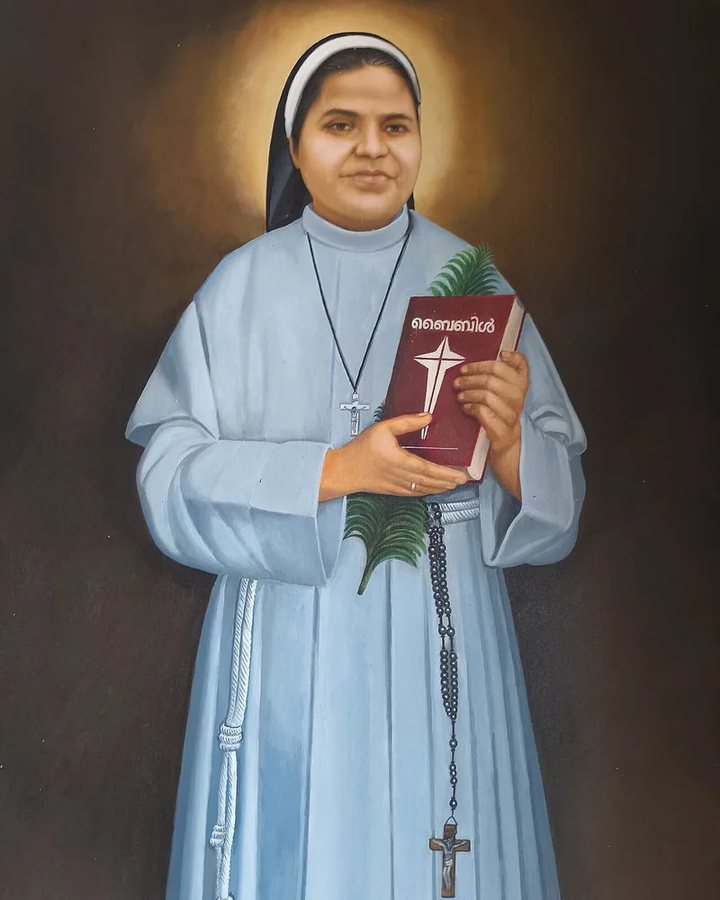 Mariam VattalilServant of God · 1954–1995Mariam Vattalil was an Indian Catholic nun and social worker belonging to the Franciscan Clarist Congregation. Born in 1954 in the Ernakulam district of Kerala, she dedicated her life to the Diocese of Indore through educational instruction and catechetical training. Her commitment to social justice and her support for the landless poor led to her murder in 1995 by individuals offended by her advocacy. She is recognized by the Catholic Church as a blessed, having been beatified in 2017.
 Mother Eliswa VakayilBlessed · 1831–1913Mother Eliswa Vakayil (1831–1913) was a Catholic nun from Kerala, India, who played a foundational role in the establishment of local religious life for women. After becoming a widow at the age of 20, she dedicated herself to religious service. She is most notable for founding the first indigenous female Carmelite community and establishing a convent in Koonammavu. Her leadership and spiritual contributions were formally recognized by Archbishop Baccinelli in 1866, marking her significant influence within the Carmelite order.
 Thomas of TolentinoBlessed · 1260–1321Thomas of Tolentino was an Italian Franciscan missionary born around 1260 in Tolentino. Known for his strict adherence to the vow of poverty, he was a member of the Spiritual Franciscans and faced imprisonment for his intense opposition to luxury. He spent much of his life traveling through Armenia, Persia, and India to spread the faith. In 1321, while traveling near Mumbai, he was executed in Thane for his blunt religious comments regarding Muhammad, dying alongside several companions.
 Gregorios of ParumalaSaint · 1848–1902Gregorios of Parumala was a prominent 19th-century Indian metropolitan of the Malankara Syrian Church. Born in Mulanthuruthy in 1848, he rose through the ecclesiastical ranks, beginning as a sub-deacon at age ten and becoming a priest in 1865. He was appointed metropolitan in 1876, subsequently overseeing the Niranam, Thumpamon, and Kollam dioceses. He is historically significant as the first individual of Indian origin to be canonized as a saint, leaving a lasting impact on the religious and educational landscape of the region.